

Sizing Electric Motors and Batteries for a Municipal Sweeper: A 4.8-Tonne Case Study
How tractive-force modeling, auxiliary power budgeting, and motor selection actually size an electric sweeper’s battery and drivetrain.
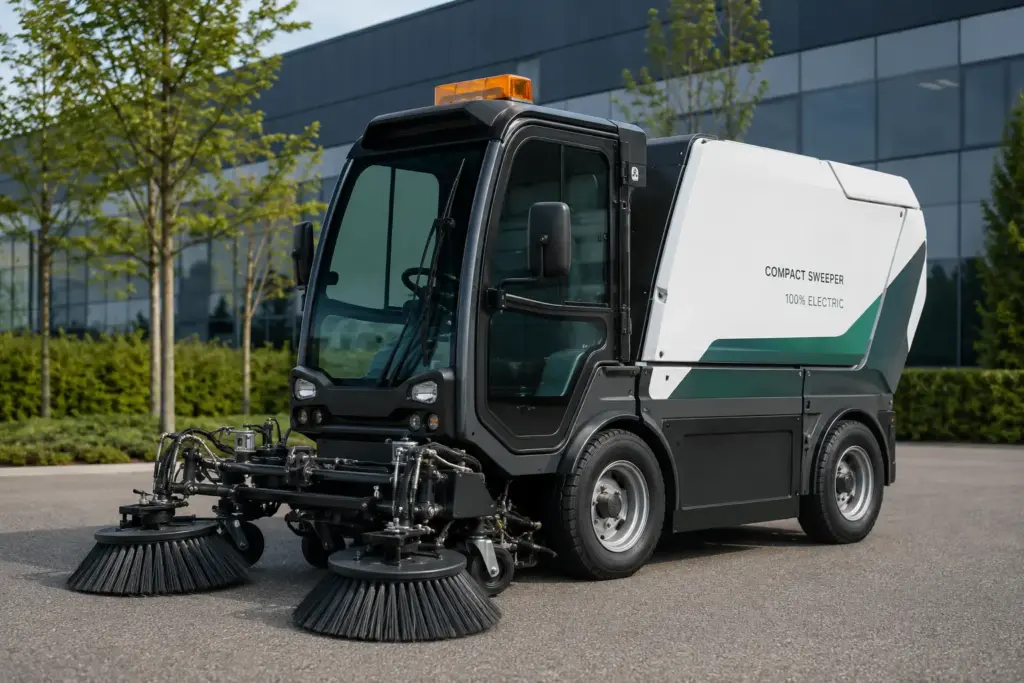
Executive Summary
Electrifying a municipal sweeper is a different problem than electrifying a passenger car. A sweeper has to drive itself down the road and run a vacuum turbine, a hydraulic pump, and a water system at the same time — often at low speed, for hours, without a break. That combined load is what actually sizes the battery and motors, not top speed.
This case study works through the complete power budget for a 4.8-tonne compact electric sweeper: tractive forces at highway speed and on a 30% grade, auxiliary loads from the suction fan and hydraulic aggregate, the battery sizing math those loads drive, and the motor and inverter hardware that covers both jobs. The traction motor tops out around 88 kW to cover the worst-case grade climb. The auxiliary side runs on two permanent-magnet motor families supplied by iNetic Traction — the iEV and sEV lines — sized for continuous duty rather than peak torque, since a hydraulic pump on a sweeper runs for hours, not seconds.
Two battery configurations cover the expected duty cycles: a 63 kWh baseline pack and a 100 kWh extended pack, both built on a 335V nominal architecture. A centralized vehicle control unit — the EVParts xCU — replaces the mechanical power take-off network entirely, handling motor control, thermal management, and safety interlocks from a single dual-core safety microprocessor.
The base platform carries over from the diesel version largely unchanged: a two-part ladder-frame chassis, articulated hydraulic steering, independent front suspension, and a Torsen self-locking differential. What changes is everything downstream of the engine bay — a lithium-ion battery, a traction drive motor, a suction fan drive, and an electro-hydraulic power pack take the place of the diesel engine and its belt-driven PTO.
